Go deeper: three books, one model.
Every building automation system is a stack of layers, each one reporting on the layer below it. Each book in the BAS Field Reference library takes one layer apart — and all three teach the same move: trace down until the evidence stops agreeing. The books explain the concepts behind the problems you practice in the labs; the labs never require them.
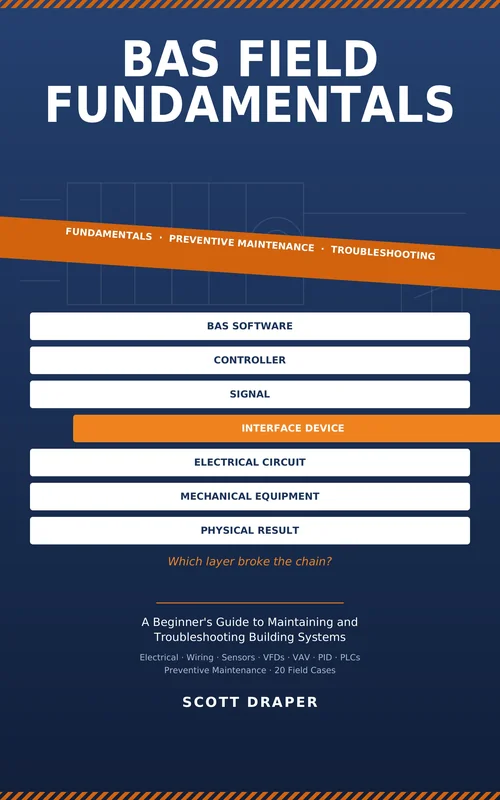
Equipment layer
Is the equipment actually doing what the point says?
BAS Field Fundamentals
A field guide for the new technician
Who it’s for: Technicians in their first years, or anyone who wants the whole trade in one place.
The foundation of the trade, taught through one building. Every chapter lives inside Memorial General, a fictional hospital followed from the central plant down to a single VAV box, so sensors, wiring, drives and sequences show up the way you’ll actually meet them.
It opens with a method, not a menu: define the complaint, find what should be happening, what the BAS believes, what the equipment is really doing — then divide the problem into layers and test the one most likely to have broken.
What’s inside
- The site and its systems — walking the building, the water side and the air side, what the BAS is doing there
- Points and sensors — point types, reading a points list, temperature, humidity, pressure, CO2, flow and safety devices, with meter tests and calibration
- Making it move — electrical fundamentals, wiring diagrams, relays and triacs, VFDs, actuators, signal types and PLCs
- Control logic — sequences of operation, PID tuning, setpoints and resets, economizers
- Trending, alarms and reporting
- Field troubleshooting — the ten-step method, VAV boxes, mechanical cause and effect, commissioning, when not to touch it, twenty field cases and the troubleshooting matrix
- Preventive maintenance — air side, water side, controls and compliance-driven PM, plus a master task list
45 chapters in nine parts20 field casesPrint and Kindle
Look inside
Practice it
The twenty field cases in this book are playable in the Diagnostic Simulator: the same buildings, symptoms and ten-step method, with a live graphic and a clock.
Practice the field cases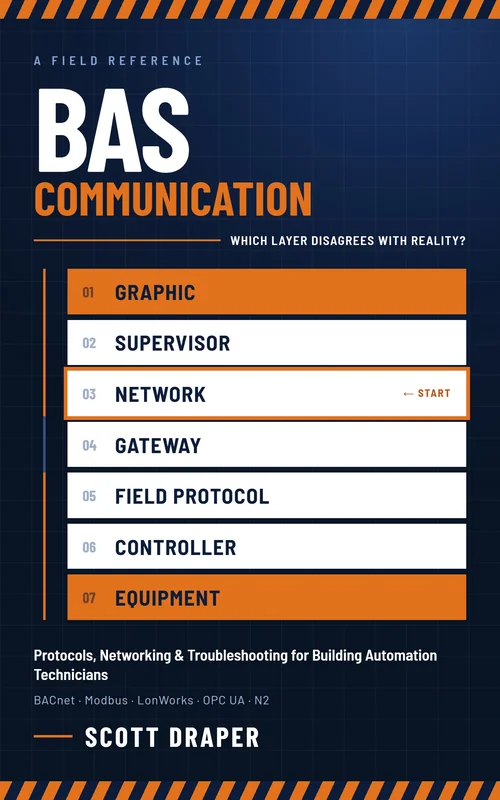
Network layer
Did the value arrive — and is it the value that was sent?
BAS Communication
A field reference
Who it’s for: Techs and integrators chasing points that go missing, stale or wrong between devices.
For the part of the job where there’s nothing left to put a meter on. Once a point arrives over a bus, the questions change: addresses, baud rates, register maps, byte order, bindings, device instances.
Each protocol gets a field workflow for getting connected and a diagnostic stop-and-check before the scenario walkthroughs, so you work the problem in order instead of guessing.
What’s inside
- BACnet — MS/TP and IP, device and object model, discovery
- Modbus — RTU and TCP, register maps, byte order, exception codes
- LonWorks, OPC UA and legacy protocols, including N2
- Gateways and point mapping between vendors
- Physical-layer testing for RS-485 and FT-10
- Networking for controls techs and Wireshark set up for BAS traffic
Print and Kindle
Look inside
Practice it
Chapters on BACnet, networking and Wireshark become hands-on in the Network Lab; the Modbus and LonWorks chapters in the Capture Lab. Several field tools come straight from the book.
Open the Network Lab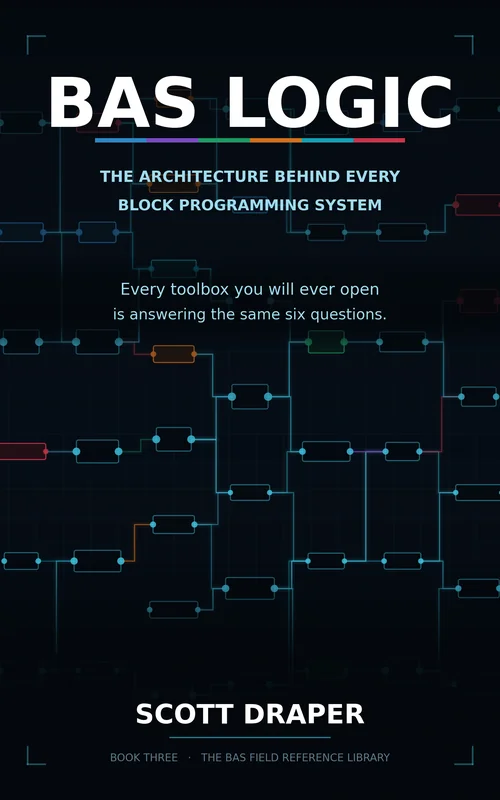
Logic layer
Is the program deciding what you think it’s deciding?
BAS Logic
Graphical programming across platforms
Who it’s for: Anyone who needs to read, write or trust block programming on any platform, including techs with no programming background.
Every vendor’s block toolbox answers the same six questions — compare, decide, calculate, choose, wait, remember — plus the PID loop, which is different because it watches its own effect.
This book teaches the architecture, not the software. There are no menus or click paths, because interfaces go stale and architecture doesn’t. Where platforms genuinely differ, it hands you the experiment to run yourself rather than a claim to take on faith.
What’s inside
- The model — the six families, execution order, and the loop that watches itself
- Reading someone else’s logic, and seeing what it’s actually doing
- Writing — the Paper Pass, six sequences, and documentation
- What goes wrong — five families of failure, and proving it before it goes live
- Crossing over — your first hour on an unfamiliar platform
- All together — one system traced through every chapter
13 chapters in six parts21 diagramsFive appendices
Look inside
Practice it
The Block Logic Lab is built on this book: the six families, execution order, the five failure families, the Paper Pass builds, and the crossing-over experiments from Chapter 12, on a live vendor-neutral controller.
Practice block logicSide by side
| Book | Layer | Read it if you… | You’ll be able to |
|---|---|---|---|
| BAS Field Fundamentals | Equipment | are in your first years, or want the whole trade in one place | Prove what a sensor, output or piece of equipment is really doing, and work any call in order |
| BAS Communication | Network | chase points that go missing, stale or wrong between devices | Get connected to any protocol, map a gateway, and read the traffic itself |
| BAS Logic | Logic | need to read, write or trust block programming on any platform | Read anyone’s logic, design a sequence on paper, and prove it before it goes live |
Where to start
Start with BAS Field Fundamentals. It’s written for your first year, and the rest of the library builds on its method.
Go to BAS Communication when the equipment is fine and the data isn’t.
Pick up BAS Logic when you’re reading or writing the program itself.
Bulk orders for crews and apprenticeship programs: svdraper@basfieldreference.com
Hear about new releases
Book releases, new articles and new tools — sent when there’s something worth reading.